
Saving Face
Empathy in the digital world, and how you can preserve it

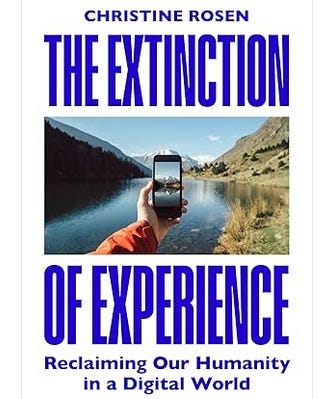
Every pandemic has changed the world. COVID-19 is only the most recent example. In The Extinction of Experience (2024), Christine Rosen argues that the smartphone has changed the world more rapidly and more dramatically. Technology has shrunk the world of human experience while claiming to enrich it. Fortunately, Rosen also points out that we have some recourse.
Studies in the post-COVID period noted a decline in personal interaction and in what we generally call civility. One study shows that about half the population thinks that the pandemic caused ruder behavior; only 10% think behavior improved (Schaefer and Sakla). Another study shows that dangerous driving, a more significant form of incivility, is much more prevalent than it was before COVID (Jackson and Leppert).
Important parts of the social contract have been broken. John Locke’s theory of the social contract balanced the freedom of citizens with obligations to their government, a system of give and take. We accept some limits to our freedom in exchange for protection and security we would not otherwise have. The contract requires empathy and mutual understanding: we make sacrifices for the benefit of others, and they make sacrifices for our benefit. A simple example is right-of-way at a four-way intersection. People used to know that they had to take turns. This was called common courtesy. It used to be a ballet, of sorts; now it is a contest.
During the COVID-19 shutdowns, the government abused its power. From top to bottom, leaders of powerful organizations, including unions, school systems, and the healthcare industry, were quick to exploit government restrictions to their own advantage. We trapped in tyranny. What happened next? When they can, people who are tyrannized will revolt, and a form of revolt is what we now see around us. We couldn’t punish the government or the unions, but we could take it out on each other. Post-COVID, we have less empathy. We are less civil.

Rosen comments briefly on a decline in empathy—fellow-feeling—related to the pandemic (pp. 121-22). But she argues that we were already on that path. She believes that the decline in civility began in 2012 with the smartphone. That device quickly altered our relationship to those around us. We could “connect with family and friends around the world” using audio and video calls, as Face Time promised. We didn’t need to meet people outside of social media. The resulting “precipitous drop in face-to-face contact” was more pronounced among Americans, young girls especially, than among other people (Lewis, p. 36).
Mobile devices created virtual space. Users quickly realized that virtual space was easier to navigate than physical place. Virtual space offered speed and ease and protected exposure; during COVID, it also offered freedom to people who were starved for it.
Although people still argue about the origins of COVID, nobody doubts that the social and cultural changes created by the smartphone were engineered. Those changes were part of a business plan led by Meta, once known as FaceBook. Long before COVID, Meta was working to replace our relationship to physical space with a digital connection to an encompassing “metaverse.”
COVID advanced Meta’s timetable. In just a couple of years, we became dependent on the practices our tech overlords had shaped for our use and their profit. Apps for smartphones were designed to encourage ongoing engagement. Apps used techniques designed to keep users online longer, enhancing the addictive power of the smartphone. Today a considerable part of the population spends between eight and twelve hours every day on their smartphones.
Mark Zuckerberg and his allies have turned the universe into the metaverse. Do we know what that means? Universe comes from Latin “uni,” meaning one, and “versus,” meaning “turned.” Universe means, literally, “turned into one.” Latin “meta” refers to something beyond or transcending, as well as—significantly—something self-referential (meta-theory is theory about theory, for example).
By analogy to “universe,” “metaverse” means “turned into beyond.” “Metaverse” is defined by the Oxford English Dictionary as a “virtual reality environment in which users interact with one another’s avatars and their surroundings in an immersive way.” An avatar is a thing that is “beyond.” It is a graphical construct that substitutes a representation of a human being for a person. In the metaverse, users’ avatars interact with other users’ avatars. One abstraction interacts with another abstraction.
Moreover, the experience is “immersive,” meaning that it takes place within a computer-generated three-dimensional image that seems to surround the user. The immersive experience is itself an abstraction. It claims to be superior to the physical experience it replaces. The virtual experience is seen as an improvement, as being more real and more valuable than the unmediated experience we ordinarily have.
The term “metaverse” was not invented by Zuckerberg or any other tech overlord. The Oxford English Dictionary traces it to a 1992 science fiction novel called Snow Crash, written by Neal Stephenson.

He describes those present in the metaverse as avatars. In Snow Crash, the metaverse is an escape from reality. (For an extended discussion of “metaverse,” see work by the aptly named Kafka, below.)
However, the metaverse of high tech, Meta’s virtual “beyond,” is a trap, not an escape. It is an inescapable tube into which we are all funneled. In Snow Crash, the metaverse is a path to greater freedom. To some people today, that’s what Zuckerberg’s Meta promises to be. But his metaverse is in fact subversive. “Subversive” draws from the same root as “universe,” which is “versus,” meaning “turned,” and from “sub,” meaning under. Subversive is to turn from under, or to overturn. Social media are designed to subvert or undermine social experience and to replace it with virtual experience.
Zuckerberg emphasizes improved online experience as the goal of Meta. How far his ambitious reach can be seen in a random July 2025 ChatGPT summary.
Mark Zuckerberg envisions the metaverse as a more immersive and embodied internet, where users can interact with 3D digital spaces and experiences in a way that feels more real than traditional online interactions. He believes it will revolutionize how people socialize, work, and experience entertainment, offering a more engaging and personalized online experience. (emphasis added)
The metaverse at first seems to be limited to improving “traditional online interactions.” But note that the metaverse is supposed to “revolutionize how people socialize, work, and [not to be forgotten!] experience entertainment” (see Hern on obstacles Zuckerberg faces). I would say that these latter changes have already taken place. We work by ourselves (from home), socialize online rather than in person, and prefer to be entertained by screen-based content.
Rosen quotes a Meta advertisement that expresses the consequences succinctly: “The Metaverse may be virtual, but the impact will be real” (p. 207). Sounds like a threat to me.
Our tech overlords are not disturbed that the metaverse they are creating is subversive or that it derives from a dystopian science fiction fantasy, as Stephenson and Kafka show. Indeed, our overlords assure us that the new virtual world will be more exciting than the world we now live in, although they do not tell us that the metaverse is, and will be, entirely under their control. Much of what we do already is serving their capitalist interests. Soon everything we do in it will be collected as data for their processing and profit.
Rosen points to the way in which “persuasive technologies” seek to change our behavior. “What the clock did to time,” she writes, “technologists hope to do to emotion—regulate and regiment it measure and monitor it” (p. 114)—and, of course, profit from it. No one seems to be bothered by this commercial colonization of private life.
Emotions “use our bodies as their theater,” Rosen writes. When that theater “becomes virtual,” we become less adept at reading the emotions of others and at developing the skills that are basic to human interaction (p. 117, citing Antonio Damasio). You might say, to stick with the analogy, that we forget how to act.
Rosen quotes a comment in which Google’s Head of Strategic Planning praised YouTube as “our global campfire” (p. 125). This is the perfect metaversal absurdity, idealizing a campfire that offers no fire or heat or light. The Google boss knows that your campfire tale will make her richer. We will gather round YouTube. In 2025, YouTube became “the world’s No. 1 source of video entertainment,” bumping television from its dominant position (Fritz).
Why do free people cooperate with a project that subverts freedom and independence and, unbeknownst to them, clouds their sensitivity to other people? We know that, since the introduction of the smartphone, people set a higher value on being entertained than on being social, including talking face-to-face. “Social media” is deeply anti-social, as Rosen notes when she describes people walking into other people because they both are looking at screens. They can’t put down their phones because they are addicted to being entertained. If she is right, this is the future of the human race.
Rosen cites studies that show the difference between entertainment, which does not make demands on us and gives us easy pleasure, and art, which demands a price for the pleasure it offers (p. 163). People usually opt for entertainment, and that’s what small screens offer. Art, we can say, is public and social. Entertainment can be either public or private. When it is delivered by a small device and reaches a single user, it can be antisocial. For the user, the little world of the screen is an everywhere. Walking down the street, the user is not in a social situation but instead in a protective bubble that keeps other humans at a distance. Others must look out for the user, who does not look out, literally, for anyone.
When young people who are used to hiding behind their screens are forced into social situations, they call it “adulting,” including doing such mundane things as laundry, cleaning the sink, washing dishes, and other chores. Grappling with art is form of adulting. Staring at your screen is not.
Being entertained by a small screen means giving up an identity rooted in time and place. Rosen argues that place hardly matters any longer, and that privacy has been redefined. She follows Drew Austen in claiming that “networked products” are the new “common ground.” Think of the “global campfire” of YouTube as “common ground.” The “shared experience” that comes with “physical proximity” is being replaced. People are “ignoring one another, doing their best to be nowhere” (Austen, qtd. Rosen, p. 201). To be nowhere in the everywhere is the new goal of society. We watch the screen, unaware that it is watching us.
When they tune in, users are no longer from New York or New Mexico. Instead, users live in a single virtual space, which can now be homogenized by headsets and, eventually, by implanted chips. That is a vastly expanded world, of a kind: a world “beyond the world,” a metaverse. Such a world was already envisioned in 1984. It will be here by 2034 and probably sooner.
How to anchor ourselves in time and place? One way is by reading. Writing is another.

In Inside the Chanted Hour, Meghan Cox Gurdon points out that books are “a great reverberating conversation across centuries,” forming a community of the living and the dead held together by reading. She notes that in a recent study only five percent of English majors at two schools could make sense of Dickens’s Bleak House. The analytical skills of college students have declined to abysmal levels. On their phones, they don’t have to analyze anything. Do they even know what it means to do intellectual work? To read? To interpret? To disitnguish metaphors from similes?
The encouraging word is rare in Rosen’s book, but it is there. She reminds us that new technology does not necessarily replace the old. The printing press did not make handwriting irrelevant even as it revolutionized the transmissions of knowledge (p. 77; on printing, see Eisenstein).
The pre-smartphone generation will soon be replaced by people who know only smartphones (and devices that will come after them), people for whom physical, localized experience will become extinct, as Rosen predicts—unless we do something about it. With Rosen’s and Gurdon’s help, we can make sure that some traditions, reading, meeting face-to-face conversation, and others, will continue. They are too robust and satisfying to be replaced by devices.
Likewise, the merits of working with one’s hands—using skills other than pressing keys, that is—need to be appreciated. Rosen points out that skills such as handwriting are deeply rewarding for those who learn them. Teaching handwriting may be a coming thing (p. 215). And some people still want to bake their own cakes and grill their own steaks.
The Extinction of Experience is an important step in the recovery process. “Accounting for what we have lost is also the beginning of the process of reclaiming it,” Rosen writes (p. 218). Rather than elegize social traditions and hand-powered projects, her book pushes back against the dehumanizing effects of social media.
We can join the effort by promoting traditional experiences. We can make them happen and we can pass these traditions on to those around us. I see four paths: meet; observe; create; and rest.
Meet
First, we can meet people face to face rather than screen to screen—lunch, a drink, a conversation at the current version of the storied water cooler.
Observe
Second, we can look at things and take them in, process them, analyze them, listen to them. Recording an experience now takes the place of having experience. Many people prefer to take a picture of something rather than look at it. Taking a pcture of it means you don’t have to look at it. At concerts, performers fill the stage. In front of them are walls of small screens recording the show. What becomes of these billions of images stored on millions of smartphones? Does anyone actually look at—i.e., experience and analyze—these images? It’s more important that the images, the data, are transmitted than that they are understood.
Create
Third, we can do things with our hands. The advantages of working with your hands are obvious to anybody who lives an active and productive life. Cooking is better than ordering out. Exercising is better than watching somebody play a game. Handwriting is better than typing—better in the sense of being more beneficial, if not faster. The secondary—watching rather than doing, that is to say—has become the primary, and doing anything by hand, except typing or swiping, seems to be passé. This should not be the case, because as the hand works, it develops and exercises the brain in specific and well-understood ways.
Rest
Fourth, we can reacquaint ourselves with the value of solitude and inactivity. We call this idleness, which is a shaming and negative term that means being lazy or unproductive. But idleness can be helpful and necessary. Idleness is a form of rest; everybody needs to rest.
Through social media, our brains are bombarded with images and messages and are constantly buzzing. People are talked to by devices; they don’t seem to see the value of talking to themselves, or, to put it another way, of listening to their bodies. Our smartwatches and phones supply metrics that tell us how well we are. We don’t have to live that way. I use my FitBit to count my steps and to evaluate my sleep. I don’t need its many “wellness” functions to tell me how I feel.
Our high level of being busy keep us from paying attention to ourselves and to others, and leads to anti-social behavior. Rosen summarizes studies that connect the decline in face-to-face contact to a drop in empathy, which one study shows to have declined by 40% since 2010. How do we measure something like that? Ask people how they feel about the suffering of others. College polls show that up to half the students thought that the 2024 murder of UnitedHealthcare CEO Brian Thompson, who was gunned down on a New York street, was “completely justified” or “acceptable.”

1974-2024
Progressive Democrats dismissed or rationalized this murder. Massachusetts Senator Elizabeth Warren’s response was to denounce the “vile practices” of insurance companies and to justify the “visceral response” some people had to them—including, presumably shooting insurance executives in the back.
Connecticut Senator Chris Murphy set Thompson’s death against what he claims are “thousands of people” who die every day because of the health care industry. He does not seem to know that thousands of people live every day because of the health care industry (see MacDougald).
Progressives, whose empathy for themselves is boundless, don’t care about other people. It’s not their smartphones that coddles their ignorance. We can attribute that to their hip teachers and to their unchecked narcissism. Smartphones have protected them from the world. These people are apostles of diversity when it suits them. But they regard those who disagree with them as less than human, as evil-doers who should be eliminated, by violence if necessary. Their lack of fellow-feeling—the inability to understand that the man getting shot be one of their own kind—is pathological.
To them, cold-blooded murder is “completely justified” as a method. I don’t spend much time with Reddit posts, but I note that nearly 20% of those who posted wished that the would-be killer’s bullet had not missed President Trump. The percentage of people who hold that view is probably larger. To Rosen, this extraordinary change in what it means to be human is part of transformation of the modern mind initiated by digital technology.
Our culture, Rosen writes, values digital experiences more than direct experience. “Daily intimacy with the physical world recedes, little by little, while our attachment to digital worlds grows.” Now “being there” means “being there virtually.” We offload perception, analysis, fellow-feeling, and introspection, to technology. We fill our time with screen-driven entertainment. The result? “We are changed,” Rosen says (p. 17), and she does not mean for the better.
July 2025
Sources
Eisenstein, Elizabeth L. The Printing Press as an Agent of Change. New York: Cambridge University Press, 1979, repr. 1997.
Fritz, Ben. “The Channel We’re All Watching Is . . . YouTube.” The Wall Street Journal. July 19-20, 2025. P. A1.
Gurdon, Meghan Cox. “Put Down the Phone and Pull Out a Book.” The Wall Street Journal. July 23, 2025. P. A13.
Hern, Alex. “Mark Zuckerberg’s metaverse vision is over. Can Apple save it?” The Guardian. May 21, 2023. https://www.theguardian.com/technology/2023/may/21/mark-zuckerbergs-metaverse-vision-is-over-can-apple-save-it. Seen July 18, 2025.
Jackson, Anna, and Rebecca Leppert. “Many Americans perceive a rise in dangerous driving; 78% see cellphone distraction as major problem.” Pew Research Center. November 12, 2025. https://www.pewresearch.org/short-reads/2024/11/12/many-americans-perceive-a-rise-in-dangerous-driving-78-see-cellphone-distraction-as-major-problem/. Seen July 17, 2025.
Kafka, Peter. “Snow Crash author Neal Stephenson predicted the metaverse. What does he see next?” Vox, 2023. https://www.vox.com/technology/2023/3/6/23627351/neal-stephenson-snow-crash-metaverse-goggles-movies-games-tv-podcast-peter-kafka-media-column. March 6, 2023. Seen July 15, 2025.
Lewis, Michael J. “A Masterpiece of Melancholy: On Christine Rosen’s The Extinction of Experience.” Commentary, February 2025. 159.2, pp. 34-37.
Lorenz, Taylor. “Why We Want Insurance Executives Dead.” https://www.usermag.co/p/yes-we-want-insurance-executives.
Rosen, Christine. The Extinction of Experience: Being Human in a Disembodied World. New York: W. W. Norton, 2024.
Schaeffer, Katherine, and Beshay Sakla, “Almost half of Americans say people have gotten ruder since the COVID-19 pandemic. Pew Research Center. March 12, 2025. https://www.pewresearch.org/ short-reads/2025/03/12/almost-half-of-americans-say-people-have-gotten-ruder-since-the-covid-19-pandemic/. Seen July 17, 2025.