
Appetite for Risk
Thomas Mann, "The Black Swan," and "Death in Venice"

The Black Swan is among the least-known of the novels of Thomas Mann. It appeared in 1954, the year before his death. The book has many connections to Death in Venice, which was published in 1912 and which is probably Mann’s most famous work.
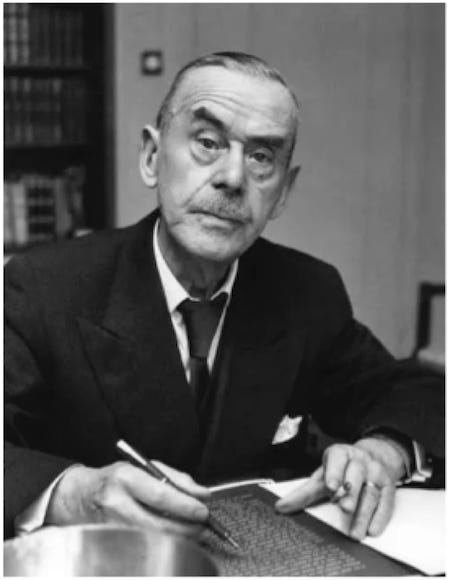
Mann is said to have denied connections between the two tales, and Nina Pelikan Straus, a Mann specialist, has underscored the differences between them. She argues that The Black Swan is a woman-centered narrative that differs from what she calls the “epic” works (Buddenbrooks; Joseph and His Brothers, Tonio Kroger) that are chiefly about men (p. vii). Death in Venice is not an “epic” work, however, and many points connect it to The Black Swan. One of them is that love is risky business.
Lovers know that. Mann’s elder lovers confess their love. In Death in Venice the once-dignified but now “overwhelmed, and shuddering” Gustav von Aschenbach exclaims to the absent beloved, “I love you” (end of ch. 4, p. 341). In The Black Swan, Rosalie, “overwhelmed with shame, terror, and bliss,” confesses to herself: “Good God, I love him, yes, I love him” (p. 49). How do these people, bastions of propriety, arrive at such a state? Love seems unfamiliar to them, as if it were something that had been forbidden by an austere code that had once passed for prudence and common sense.
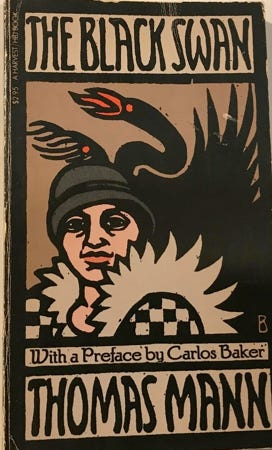
Harcourt edition, 1980, cover design by Bascove
Satisfaction in love, or art, is elusive. Yet both novellas show that even unrequited love comes with rewards that are, if only in a limited sense, satisfying. In modern fiction, satisfaction is seldom complete. At the end of Virginia Woolf’s To the Lighthouse, for example, the painter Lily Briscoe feels extreme fatigue. But as she puts down her brush, she thinks, “Yes, . . . I have had my vision,” and for her that realization suffices (p. 310).
For both literary characters and readers, dissatisfaction seems to be a product of modernism of the kind we see in works by Woolf and Mann. The elderly lovers in Death in Venice and The Black Swan could, like Lily, have said that they too had had their vision and were satisfied. However one-sided, their love was an adventure to be savored. That their beloved young men, the Polish boy in Venice and the American tutor in Düsseldorf, are barely aware of the struggling desires of their admirers hardly matters.
Each work ends with the elder lover’s peaceful death. To their last breaths they cling to dreams of happiness that have, sadly, constituted the sum and substance of their romance. They have fallen in love with their own fabrications and, in the end, I believe, they know that they have. Is that enough for them? It seems to be. Is it enough for us?
That Death in Venice is far superior to the later work nobody would deny. A famous writer, Aschenbach is walking in Munich. He sees an ominous stranger, a figure both majestic and savage, and this disturbing vision inspires him to travel. He imagines a tropical landscape, but it is no paradise, for that landscape includes the glowing eyes of a tiger—danger and risk. Yet this vision energizes Aschenbach, who is soon off to Venice to find respite from the burdens of his work. He seems to realize that the intellectual life is not as satisfying as he used to think.
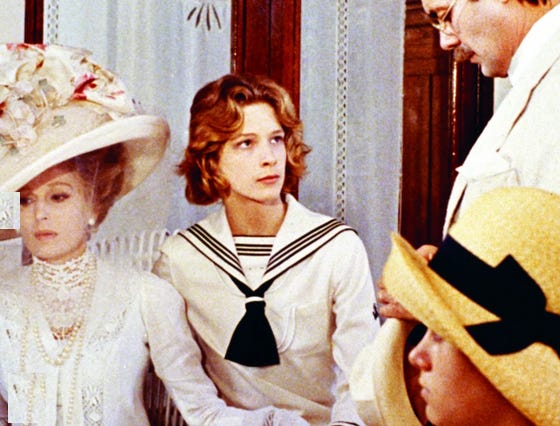
From the 1971 Visconti film: Silvana Mangano (mother), Bjorn Andreen (Tadzio), Dirk Bogarde (Aschenbach).
In Venice, Aschenbach falls in love with Tadzio, a beautiful boy. To his own (and our) surprise, he finds that he cannot free himself from this infatuation and its risks, even when his obsessive behavior leads to his humiliation. A plague descends on Venice, scattering the tourists. But Aschenbach refuses to leave. When he was strolling in Munich, he thought of travel as a “health measure” that would counter the strain of his compulsion to work (p. 290). He does not know that his unstoppable obsession with a beautiful boy poses a greater danger to his well-being.
Packed with tortured eroticism and foreboding, Death in Venice has inspired several works in other media, the most famous being the 1971 film adaptation by Luchino Visconti. In the film, Gustav von Aschenbach is a composer, not a writer. The film is enriched with music from two symphonies by Gustav Mahler, including the celebrated Adagietto from Symphony No. 5. The novel was adapted as an opera by Benjamin Britten in 1972. Illness is part of Death in Venice and, curiously, is also part of this opera’s history. Britten was so unwell that he could not attend the first performance, although later that year he attended a performance at Covent Garden (Oliver, pp. 202-4).
Compared to the illustrious reception of Death in Venice, the reception of The Black Swan was negligible. It is a domestic drama that takes place in the mind of Rosalie, a woman of fifty who is walled-in by family tensions. A dreamy romantic, she lives with her two children, Anna, her unmarried, disabled, and coldly analytical daughter of 30, and Rosalie’s son Eduard, age 18. Rosalie hires a new tutor for Eduard, a man named Ken Keating. Boyish, well-built, and an American who loves German culture, he is also a U.S. Army veteran who was seriously wounded in World War I. Ken becomes Rosalie’s obsession.
When she describes her infatuation to Anna, the younger woman dismisses the importance of feelings and tells her mother that Keating is not worthy of her (p. 70). She urges her mother to look at him as he actually is, not as he appears through the “transfiguring light” of her love (p. 71). Keating lost a kidney when he fought in Germany. But he loved the country and stayed there after the war to teach English (p. 35). His injury fuels Rosalie’s heroic view of him. Anna, in an ugly moment, describes the injury as an sign that he is not a complete man, perhaps a sly hint that he might be sexually unsatisfying.
Little has been written about The Black Swan, and I know of only one adaptation. In 1996, Swarthmore College faculty members Thomas Whitman (music) and Nathalie Anderson (text) collaborated on a two-act chamber opera based on the novel (a few audio clips are available at his website; see below). Opera doesn’t need action in order to be great; it needs a compelling plot and good music. I imagine that Mann’s story about Rosalie could serve as the basis for a one-woman stage performance, perhaps something like Francis Poulenc’s La Voix humaine (1958), a work for soprano and orchestra lasting less than an hour.
The most striking feature of The Black Swan is Mann’s focus on Rosalie’s menopause and the part it plays in her obsession with Keating. The medical side of her history has been discussed by Aino-Maija Lahtinen and Martina Torppa. They write that, in 2001, a dozen medical students in Finland were asked to read the novella. The students’ responses to the “medicalisation of Falling in Love” were muted, “perhaps because the openly erotic and uncontrolled nature of the relationship made the students unwilling to deal with it,” which is to say, obviously, that they were not satisfied (p. 47). For them, the text said too much.
There is no question that medicalization of “Falling in Love” places some repellent effects front and center. Rosalie has no sense of risk. She is convinced that her love for Ken has reversed the aging process. As she falls in love, she believes that her menstrual blood has returned. Love has made her young, she thinks, and prompted her body to regain its earlier fertility.
Rosalie is experiencing more than dopamine-induced euphoria and energy, it turns out. A master of dark surprises, Mann uses the commonplace sentiment about the transformative power of love to conceal an ugly fact: the cause her bleeding is ovarian cancer. Only when she is sick enough to see a doctor does she learn the truth.
Her age is not all that, in her mind, Rosalie’s passion reverses. Her euphoria reveals a new view of herself. She remembers that, when she was younger, her husband desired her. At that time, she merely acquiesced, not especially desiring him. Indeed, she was not even aware of what marriage would involve sexually. Hers was a response without energy. Now, however, as an older woman, she believes that she looks at Keating in the same way that a man looks “the young woman of his choice.” She adds, “This time it is I who desire, of my own will and motion” (p. 50). Her decisiveness and her willingness to take rises are, in her view, signs of masculine power. And so, apparently, is her hunger for sex.
The Black Swan confirms what we already know about Mann as a writer more interested in philosophy than in drama. In Death in Venice he minimized the romantic elements that the city of Venice might have infused into the story of Aschenbach. Instead he emphasized a schematic design that juxtaposes the rational north (life and work in Munich) and the passionate south (death and love in Venice). Then Mann uses Aschenbach’s hesitant and faltering actions to show that intellect and wisdom fail when confronted by passion and impulse.
Confined to a domestic world, The Black Swan offers less. It seems to be almost all conversation. The central character is not a formidable thinker, so there is little of the knowing commentary that describes Aschenbach’s folly. Lengthy conversations between Rosalie and Anna allow the mother to celebrate her passion. The daughter diminishes that passion and expresses what seems to be the narrator’s own disapproval of it. Anna’s constant reproaches are unkind, but they are sensible. If delivered to Aschenbach, they would have saved him some grief. Rosalie merely smiles at hearing what Anna has to say and then ignores the risks she has pointed out.
In The Black Swan, Rosalie thinks that her experience has made her wiser as well as younger. She eventually sees the futility of her love and abandons hope. She tells herself that she has chosen death. But she is wrong, for death—that is, cancer, her lurking tiger with glowing eyes—has chosen her.
Compared to Death in Venice, The Black Swan has neither depth nor charm. It labors to replace both qualities with medical details. Like his elderly lovers, perhaps the elderly Mann thought that in this late work he could take his own risks and get away with anything, including description of the vivid facts of Rosalie’s cancer, uncomfortably close to her thoughts about sex. However informative, the facts are as repellent as her attempts to appear young. They include recourse to hair dye and to makeup. In Venice, Aschenbach used the same devices (pp. 360-61).
The Black Swan also lacks gravity. When the world learns of Aschenbach’s death, there is something like universal shock. The poor woman in The Black Swan is at least mourned by her daughter and son, but her passing, even to herself, is expected and unremarkable, an inevitability. Perhaps she shares Aschenbach’s power to ignore the evidence and to shape one’s own world. To many people that is a kind of heroism.
It’s too bad that the German title of Die Betrogene was translated as The Black Swan. German “betrogene” means “deceived.” True, there is a black swan in the book, an ugly beast that hisses at Rosalie until she tosses some bread to it (p. 124). On her deathbed, Rosalie seems to interpret the swan’s anger as a curse (p. 139). Straus argues that the hissing swan recalls “the betraying serpent of Nature’s Eden” (p. x). But the serpent in Eden was a deceiver who did not hiss a warming.
We must compare Rosalie not to Eve but to Anna, who is, Joseph Mileck argues in his comparative study of The Black Swan and Death in Venice, the hero of the work (p. 129). Having been cruelly disappointed by a callous suitor, Anna then foolishly turned away from love. Later Anna sees her error and understands that her bitterness and isolation are the price of her rejection of love.
Near the end of the book, Rosalie and Ken visit a castle famous for its trick mirrors and secret passages, including one that leads to “darkness and exhaling an odor of mould (p. 130). They enter. Surrounded in darkness, Rosalie embraces Ken, who embraces her. “I love you,” she tells him, and she asks for his “dear lips.” They kiss. “It is you it you at last, this is your hair, this is your mouth, this breath comes from your nostrils.” It was “your body’s warmth that I relished and the swan was angry . . .”, she says (p. 132). Her words trail off. She seems unable to link Ken’s warmth to the angry bird. Me too. Was the swan angry with her for not acting her age?
Rosalie regrets kissing Ken in place of decay and says she will come to his bedroom the next day, or even that very night. But Rosalie becomes very sick the next day and is taken to a hospital, where her doctors, opening her, find her full of cancer in advanced stages. Before entering a “uremic coma” and losing consciousness, she “often remembered the swan” and his “black beating wings” (p. 140).
About to die, Rosalie urges Anna to see death as “a great instrument of life.” Death “borrowed the guise of resurrection, of the joy of love.” She denies that nature deceived her. The joy of her last weeks “was not a lie, but goodness and mercy.” It is safe to say that a more sentimental Aschenbach might have said the same thing.
Mileck points out that Rosalie is, up to the moment of her death, self-deceived (pp. 128-29). She has mythologized nature and in doing so she has misunderstood it, and perhaps got the swan’s message wrong also. She has transformed nature into a friend who has smiled on her. As Mileck says, however, it was not nature that tricked Rosalie but rather she who tricked herself.
She reaches a moment of reckoning about her poor choices. No longer content to see nature as her friend, as she has so often claimed, she now understands her bleeding and her cancer as forces of nature, which itself is neither good nor bad. Cancer is Rosalie’s version of the tiger eyes that, lying in wait, glowered at Aschenbach. We don’t know if he reached a moment of recognition comparable to hers, and perhaps Death in Venice is all the better for Mann’s silence on this point.
November 2025
Sources
Anderson, Nathalie. The Black Swan, libretto. Chamber opera in two acts, after the novella by Thomas Mann. Music by Thomas Whitman. 1996.
Feuerlicht, Ignace. Thomas Mann. New York: Twayne, 1968.
Lahtinen, Aino-Maija, and Martina Torppa. ‘Medicalisation of Falling in Love’: medical students’ responses to Thomas Mann’s The Black Swan.” Medical Humanities, Edition of Journal of Medical Ethics. 33 (2007): 44–48.
Mann, Thomas. The Black Swan. Trans. Willard R. Trask. New York: Knopf, 1954.
——-. Death in Venice and Other Tales. Trans. Joachim Neugroschel. New York: Viking-Penguin, 1998.
Mileck, Joseph. “A Comparative Study of Die Betrogene and Der Tod in Venedig.” Modern Language Forum 42 (December, 1957): 124-129. https://archive.org/details/sim_modern-language-forum_1957-12_42_2/page/128/mode/2up
Oliver, Michael. Benjamin Britten. New London: Phaedon, 1996.
Straus, Nina Pelikan. Introduction to The Black Swan, by Thomas Mann, translated by Willard R. Trask. Berkeley: University of California Press, 1990.
Whitman, Thomas. The Black Swan. Chamber opera in two acts, after the novella by Thomas Mann. 1996. Libretto by Nathalie Anderson. https://twhitman.com/works/operas/
Thank you Allen. I was not familiar with the Black Swan. Fascinating connections and observations. You have made me want to have a look at it!