
Agee Agonistes
The Hell of a Writer's Life

James Rufus Agee (1909-1955) is known for two books, Let Us Now Praise Famous Men and A Death in the Family. But for many readers, he is the author of “Knoxville: Summer of 1915,” a prose poem published in The Partisan Review in 1938. “Knoxville: Summer of 1915” later served as the basis for a moving work of the same name by the American composer Samuel Barber.
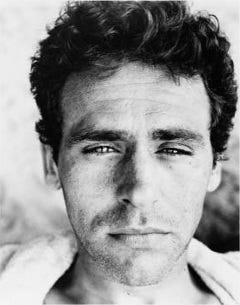
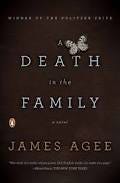
A Death in the Family was adapted for stage, film, and television, and won a Pulitzer Prize in 1958, after Agee’s death. Agee went to Harvard. He was a skillful screenplay writer. The African Queen, which he wrote with director John Huston, was nominated for an Academy Award in 1951. Agee published film criticism in both The Nation and Time. Those essays comprise two of the six volumes of The Works of James Agee published by the University of Tennessee Press.
Agee was a man of distinguished accomplishments, although his native Tennessee was slow to recognize his achievements (Brown, p. 8). He was also something of a rogue. His lifelong friend Dwight Macdonald pronounced Agee “the most copiously talented writer of my generation,” but added that, because of Agee’s chaotic life, he remained “a shameless inopportunist” (Schwarz).
Agee is still seen as a small-town genius and a romantic. Especially influential was Macdonald’s claim, which appeared in The New Yorker in 1957, that Agee had led a symbolic life and was “a literary James Dean” (Lofaro, p. xi). More recent commentators have sought to define Agee as a commercial writer and to focus on his screenplays, often ignoring the importance of his Knoxville roots to his work (Brown p. 3).
Agee remains a romantic figure. His life was hell, and he did his best to keep it that way. Told that heavy drinking would kill him, he drank more. He had multiple heart attacks but smoked constantly. His last heart attack killed him—in a Manhattan cab, on the way to the ER. He was 46. Biographer Laurence Bergreen writes that Agee “too dependent on alcohol not to drink” (p. 358).
Addiction, self-doubt, and other emotional problems got in the his way. But something else prevented Agee from completing things he started, and that was his idiosyncratic idea of what writing was. For him, writing was improvised, unrevised, and unfinished—perhaps unfinishable.
In a discussion of “Knoxville: Summer of 1915,” David Paul Kirkpatrick quotes Agee’s comments on his writing method. “According to Agee,” Kirkpatrick writes, “this now legendary piece was written in an hour an a half.” He quotes Agee:
“I was greatly interested in improvisatory writing, as against carefully composed, multiple-draft writing: i.e., with a kind of parallel to improvisation in jazz, to a certain kind of genuine lyric which I thought should be purely improvised. . . . It took possibly an hour and a half; on revision, I stayed about 98 per cent faithful to my rule, for these “improvised” experiments, against any revision whatever.”
For Agee, writing was more like performing than fixing words on paper. He sought to create work that was “purely improvised.” Many writers improvise as they invent or discover ideas, but most of them then rewrite and revise. They keep some paragraphs, toss others, sleep on it, and then have another go. For them, writing begins with discovery, which leads to development. Writing was discovery for Agee as well, but for him discovery was the end, not the beginning. He had a “rule” against revision.
Given that conviction, Agee inevitably left many lose ends. Editors and critics have been inclined to tie them up and make his words and projects into what they think they should be. For example, McDowell printed “Knoxville: Summer of 1915” as a preface to A Death in the Family, although there is no evidence that Agee thought of that himself. The shorter work was written in 1938, whereas A Death in the Family appeared posthumously in 1957, based on notes and drafts that were written in 1947-48. This is how editors shape Agee’s canon, in the process claiming that they are honoring the author’s intention.
Those who want to honor Agee’s original intentions should print stages of his writing. Michael A. Lofaro does an admirable job in this regard with A Death in the Family. In an edition of nearly 600 pages, the “finished” text comprises about 350. The rest is apparatus that reproduces stages of Agee’s improvisations.
Having studied all the material related the text, Lofaro decided that the work previously known as A Death in the Family was “far more a construct of its editors than [of] its author.” Lofaro had to undo their work. Editors had omitted more than ten chapters, divided some, constructed “flashbacks” by reordering chapters, and so on, as with McDowell inserting “Knoxville: Summer of 1915” as a prologue to the novel. Lofaro sought to present the novel as it was at the time of Agee’s death (p. xiii)—which is to say, to show that was unfinished, a work in progress. Nonetheless, he too produced what would be seen as a definitive editorial version.
Agee’s aversion to a fixed or settled text has roots both in his subject matter and in his psychology. His fiction is autobiographical. It juxtaposes childhood memories with the facts of his adult self. To distinguish Agee the adult from his childhood persona, I will follow biographer Paul S. Brown in referring to the young Agee as Rufus, which was the name he used and was known by. That was a family name, his middle name, and also his nickname (Brown, p. 3).
In A Death in the Family, Rufus and his sister, Emily, watch adults and their behavior closely and sometimes use the adults’ reactions as a guide to their own reactions. When death intrudes into the family’s peaceful routine, the gap between the children and adults widens. The adults must tell the children that their father has died, but they cannot decide how this should be done.
The divide between adults and children is evident in early chapters of A Death in the Family. When Rufus’s mother became pregnant, neither his mother nor his grandmother believed that Rufus should know that his mother would soon have another child. Presumably they considered it indecent to refer to the natural process through which children are created. By this they meant the whole business sexual intercourse, pregnancy, and delivery, as if children could deal with all of these processes. I suppose we must give the elders credit for not bringing a stork into it, which would be easier for a child to understand.
Before the baby is born, both Agree’s father and his grandfather argue that the secrecy is foolish (chapters. 7-9; see pp 62-63). Rufus stayed with his grandparents when the baby was born. Then they take him to see the baby, having told him to expect a wonderful surprise. He sees the baby in her bassinet and, having waited patiently, then asks, “Where’s the surprise?” (p. 81).
This incident shows that the adults made erroneous assumptions about the boy; they are the ones who, in the end, look silly. They feared that they might have to explain where the baby came from. To Rufus, in any case, “a surprise” should be something more exciting than a new sibling.
Agee understood the value of putting both adult awareness and a child’s point of view into his boyhood mind. Rufus is aware that things are being withheld from him. This inevitably arouses his curiosity and leads him to speculate about the adults’ need for secrecy and to become suspicious of it.
Throughout A Death in the Family, Agee balances secrecy with discovery, contrasting the innocence of Rufus to his emerging awareness as a man. Agee offers a clue to his method in the first sentence of “Knoxville: Summer of 1915”: “We are talking now of summer evenings in Knoxville, Tennessee in the time that I lived there so successfully disguised to myself as a child” (Lofaro, p. 565). It is as if Rufus, on the quilt with his family, were both Rufus and his adult self.
This device—“disguised to myself”—explains why Rufus is never free to be, simply, a child who has his own ideas of the world. Instead, he lives in a quiet hell of apprehension, constantly aware that the things and people around him are not what they appear to be and that he too, as a child in disguise, is part of this doubleness. The adults do not know that he knows about them.
A cloud of apprehension hovers over A Death in the Family and shadows the book’s central event, the death of Rufus’s father. That event inflicts a wound from which the boy will never recover. His father, Hugh James Agee, known as Jay, is manly, strong, and tender. He is a man who is not afraid to break through the barriers society has constructed between him and his son. The scenes of intimacy between Jay and Rufus are the finest passages in A Death in the Family. They constitute one of the fullest and most moving portrayals of father-son relationships in American literature. Two episodes demonstrate Agee’s success in exploring son and father.
Rufus is afraid of the dark. Lying in his bed, sleepless, he hallucinates and then cries out. His mother begins to go to him, but his father points out that the boy is calling for him, not for her (p. 23). As Jay opens the door to the boy’s room, the door “broke open full of gold and his father stooped through the door and shut it quietly” (p. 23). The father is surrounded by glowing light—a brilliant way for Agee to illustrate the father’s god-like standing in the son’s eyes (outsized, he has to stoop to enter). Sitting at his bedside, Jay comforts the boy, putting one strong hand under the boy’s head and with the other patting his chest. At his father’s touch, the boy feels that he must get over his fear of the dark.
“Now git on to sleep then, son,” Jay says. He rarely calls the boy “son,” Agee writes, but “when he did, they both felt shy and happy” (p. 25). The tenderness between father and son is intense and fragile.
In another episode, Rufus and his father are walking home from a movie and stop in a park. His father usually smoked during a pause like this, but one night he does not, and Rufus realizes that his father “liked to spend these few minutes with Rufus.” For ten or twenty minutes Rufus feels “a particular kind of contentment, unlike any other that he knew,” and then realizes that his father feels the same way (pp. 150-51).
And what contentment it is! His father rests his hand on the boy’s head, pushes back his hair, “and held the back of his head while Rufus pressed his head backward against the firm hand.” His father then draws the boy’s head “quietly and strongly against the sharp cloth that covered his father’s body, through which Rufus could feel the breathing ribs.” Then he lets the boy go.
Back at the house, the last thing Rufus hears as he goes to sleep is his father leaving for an unplanned automobile trip from which he will never return.
We think of Agee as a nostalgic author, looking back and remembering his life as a child. But the child in A Death in the Family can look ahead. The boy is apprehensive and keyed up, as he is in the bedroom scene. To apprehend means to understand but also to anticipate with fear or anxiety. The boy created by Agee apprehended his future in both senses of the word. He is a barometer of family pressures.
The gap between childhood and adulthood is exposed when the children learn of their father’s death. The Rufus and his sister think of death as they have known it, chiefly as something that has happened to a pet, as when a cat dies (Lofaro, p. 42).
Most animals simply die. Others die violently, killed by animals or by men and machines. The children can grasp those events. They have a repertory of violent animal deaths in their heads, but it offers them no help in understanding a man’s death, unless he died in a war. When their father dies in a car accident, they are at a loss. Automobiles were new. How could such a thing kill a man?
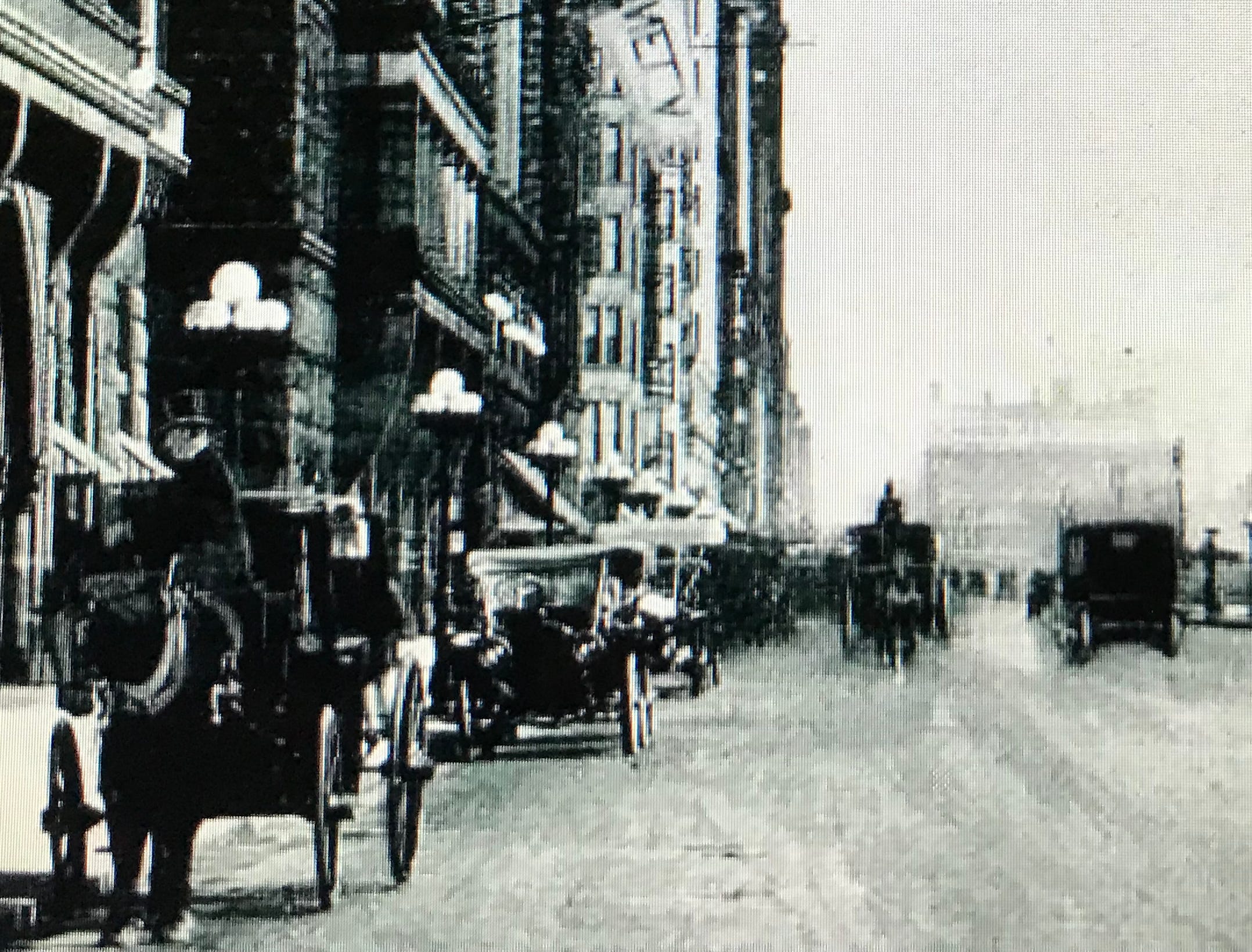
Horse and buggy and cars, Chicago, c. 1910
The arrival of the automobile age, writes George Anders, “felt overwhelming to millions of Americans.” Some of them felt that speeding cars on open roads were “annihilating” what were “longtime social norms.” Physical distance could be covered quickly, so people saw more of each other with less effort. Automobile crashes also annihilated conventional understandings. Car accidents were a new way to die. New social norms would emerge. But how, when these vehicles were new, could children understand their dangerous power? (See Brown, pp. 71-2.)
A child’s world is full of connections and juxtapositions, most of them unlikely or fanciful. Adults see the world in black and white. Children deal with the unfamiliar by means of speculation and guesswork. Children seek to know the unknown—in this case, their father’s death—through the known, i.e., the death of a pet. When confronted with death, accidental or otherwise, adults take decisive action. Hearing of the father’s death, the adults around the Rufus and his sister wash the children, put them in new clothes, and prepare them to see their father’s corpse. The adults who attend to external forms are oblivious to the children’s confusion.
Agee, however, remembered the confusion of Rufus in painful detail. He could put himself into the child’s mind. This going between two stages, boyhood and adulthood, defines his autobiographical method. He refuses to confine Rufus either to the past or to the past tense. Instead, he treats the boy’s thoughts as if they have just occurred.
Agee was many things. He resisted stability, which he confused with predictability. He deplored social norms and saw them as inadequate. Mercurial and impulsive, he was a man of many faces, contrarian and determined to ignore whatever might seem to be a sensible course of action. It is possible to suspect that, even in his maturity, he did not know who he was. However, he did know who—and what—he was not, for this is the key question in “Knoxville: Summer of 1915.”
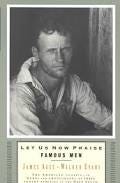
Agee did not want to be seen as a rube who acquired a lustrous finish when he left the South—that is, to be seen as a man who had been transformed as he moved up the ladder from a Knoxville neighborhood to Harvard and beyond. Instead, Agee did his best to appear and to sound like a country hick, stepping down the ladder others were eager to climb. He flouted social conventions and “remained ill-kempt and unshorn.” Bergreen claims that he wanted to be seen as “just a boy from the mountains of Tennessee—[as] anything but an ambitious literary star from [Phillips] Exeter [Academy],” or, for that matter, from Harvard (pp. 57-58).
Bergreen suggests that Agee’s ambitions were “fickle”: he assumed the role of “poet, critic, scholar, bum apostle of the forgotten man,” and others. He was unable to settle on one role, or even two (p. 77). One recalls Lofaro’s identity catalogue for the writer: “rebel, poet, mystic, martyr” (p. xi). If we merge these lists, we get seven faces for Agee: bum; critic; martyr; mystic, poet; rebel; scholar.
But history would remember him as a boy, and music would get this done.
As we have seen, Agee thought of writing as a kind of improvisational jazz. The role of music in the history of “Knoxville: Summer of 1915,” is significant. No one did more to establish Agee’s posthumous identity than the American composer Samuel Barber (1910-1981), who adapted Agee’s text and set it to music—but not to jazz.
In 1947, the American soprano Eleanor Steber commissioned Barber to set Agee’s text. She gave the world premiere of “Knoxville: Summer of 1915” in 1948. Steber had met Agee, she said in an interview with the Chicago writer Studs Terkel, and felt that Agee’s prose poem captured elements of her small-town youth in West Virginia.
“Knoxville: Summer of 1915” is regarded by many as Agee’s “signature work” and, for many, serves as a gateway to his other texts (Brown, pp. 203-4). Barber’s “Knoxville: Summer of 1915,” known to millions, is a gateway to Agee. But it is two removes from Agee’s own work. First, Barber shaped Agee’s rambling prose poem of about 1,750 words into a compact monologue of about 550 words. Second, Barber used music to animate the phrases and sentences he had chosen.
His choices differed from those of Agee. Barber avoided the modernism that overtook much American music during the first half of the last century and wrote in traditional idioms that are often described as romantic, formal, and structured. Barber favored compression, much to the benefit of Agee’s text. Indeed, his approach is the very antidote to Agee’s rambling, unstudied style.
In Barber’s setting, “Knoxville: Summer of 1915” is transformed. The music speaks as clearly as do Agee’s words. Listen to even a few minutes of “Knoxville: Summer of 1915” as sung (there are many performances on You Tube). Then read a few lines of Agee’s text—Agee’s, that is, not Barber’s (Agee’s text is printed by Lofaro, pp. 565-68). Barber’s version might be a drop of perfume, a concentrated scent with many undertones. Agee’s might be a field of flowers, beautiful but scattered.
Here is what Agee wrote:
“We are talking now of summer evenings in Knoxville, Tennessee in the time that I lived there so successfully disguised to myself as a child. It was a little bit mixed sort of block, fairly solidly lower middle class, with one or two juts apiece on either side of that. The houses corresponded: middlesized gracefully fretted wood houses built in the late nineties and early nineteen hundreds, with small front and side and more spacious back yards, and trees in the yards.” (Lofaro, p. 565)
Here are the words to Barber’s opening measures:
“It has become that time of evening
when people sit on their porches,
rocking gently and talking gently
and watching the street
and the standing up into their sphere
of possession of the trees,
of birds’ hung havens, hangars.”
For Agee’s “we are talking now” Barber writes “it has become.” We move from the personal to the impersonal, from the immediate to the remembered. Barber introduces abstraction and imagery. The porch-sitters are watching the street and observing birds, who are “standing up into their sphere of possession of the trees, of birds’ hung havens, hangars” [i.e., shelters]. As I understand it, the birds “standing up into their sphere” means “taking possession of their sphere,” i.e., taking possession of the trees. The porch shelters the people. The trees shelter the birds.
Barber’s intense compression brings the musical poetry of Gerard Manley Hopkins to mind, not the prose of James Agee, who (above) describes his neighborhood as “a little bit mixed sort of block.” Barber preserves the simplicity of the moment that Agee captures, and in the process elevates it.
Agee was, he insisted, “just a boy from the mountains.” The work’s final lines come from an adult and shadow the work with a sense of loss well beyond nostalgia. “After a little I am taken in and put to bed,” the boy says. He continues:
“Sleep, soft smiling, draws me unto her: and those receive me, who quietly treat me, as one familiar and well-beloved in that home: but will not, oh, will not, not now, not ever; but will not ever tell me who I am.” (Lofaro, p. 565)
The boy is put to bed, but he does not rest. The five-fold iteration of “not” seems oddly contentious. Those who treat the speaker “as one familiar and well-beloved” at home “will not . . . will not, not now, not ever . . . will not” tell him who he is.
But why do they withhold this information? Is it that they cannot tell him who he is because they do not know? Agee ends a paragraph that is rich in comfort and communion without offering the consolation we expect. Rejecting resolution, he asserts isolation and distance. He leaves Rufus, his childhood self, suspended in a quiet hell, without the peace that Agee sought as both man and boy. It is the hell of a sad heart, lonely and apart on a summer night, in Knoxville, Tennessee, in 1915.
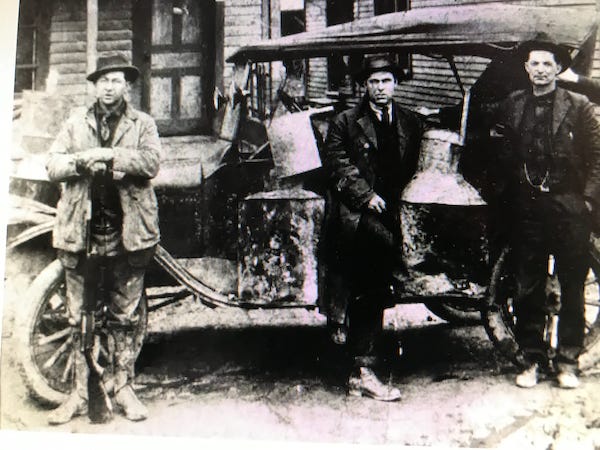
Knox County sheriff's deputies with a confiscated moonshine still circa 1922-23. Knoxville News Sentinel Archive.
June 2026
Thanks for this Allen. I was fascinated by his idea of writing as being similar to jazz improv. He was quite an interesting sort!